


REVIEW: Winston and David at The Tabard Theatre 6 – 29 August 2026
“Three years after its Edinburgh debut, this three-hander once again attempts to bring the pair back to life with a personal touch” ★★
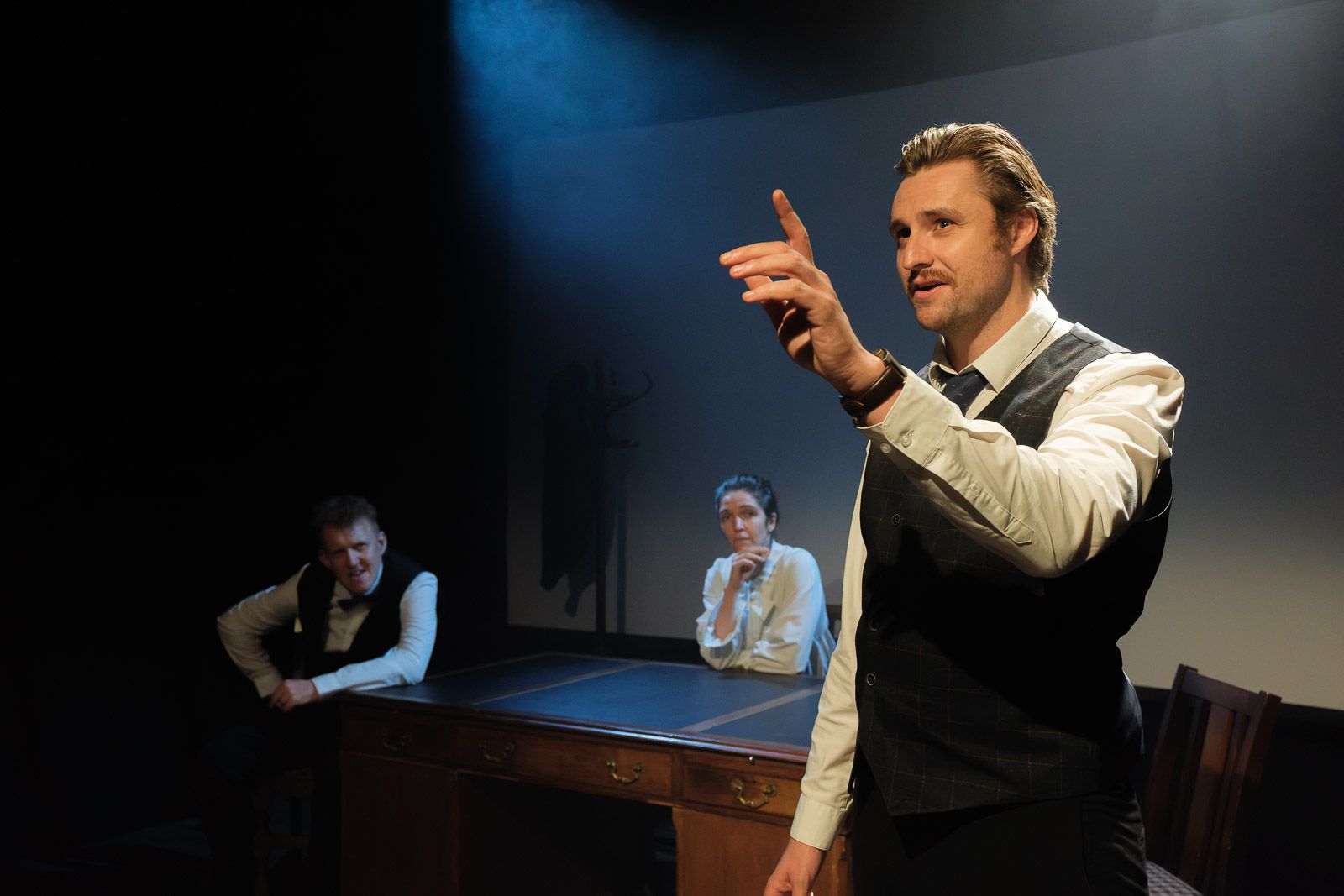
Lights fade on Winston Churchill and David Lloyd George posing together in shapes that you can still find in bronze just outside of the Houses of Parliament. Yet three years after its Edinburgh debut, this three-hander falls flat when bringing the pair back to life.
Written by none other than Robert Lloyd George, great-grandson of Welsh prime minister David, the script is informed by previously unseen family documents. But despite his well received family biography named Winston and David: How a Friendship Changed History and a decent fringe run a few years ago, the piece fails to sparkle. Instead, Winston’s rise to power and David’s fall from it becomes a list of historical events which only occasionally spotlight what bound these two together as friends.
During an obituary tribute to the House of Commons in March 1945, Winston Churchill named David Lloyd George, “the greatest Welshman which that unconquerable race has produced since the age of the Tudors.” Much time is spent showing how the respect between these two men grew in this play and yet, too long a time is spent merely affirming Churchill’s statement. Very rarely and, usually through the incredibly short speech of the play’s female characters, do we see the Welsh prime minister morally questioned.
The lack of perspective, especially female perspective, serves as a central problem. The script had ample chance to portray David Lloyd’s George’s secretary, then mistress and finally, second wife, as more than a plot device pushing the narrative forward. You cannot introduce the women surrounding great political actors by merely giving them the role of chorus. Only when Frances (David Lloyd George’s mistress) refuses to marry after becoming pregnant does the Welsh PM finally take shape in front of our eyes. David Lloyd George was both the man who would suggest his mistress remarry to cover up a potential child but also the politician who so well advocated for the votes of women.
The acting is also unbalanced. Peter Swales quickly becomes the ‘bull dog’ in Churchill we have come to know so well and invites us into the contradicting obsessions — namely painting, warring and drinking — to great effect. Joseph Emms’ Lloyd George, more cartoonish and less convincing, struggles to make himself properly known to the audience. Alexandra Donnachie switches at pace between female characters but never really loses the austere look of David Lloyd George’s mistress.
Theatre scripts can always work as active, full-bodied, history lessons and yet, the balance between both must be maintained if a show doesn’t want to feel like a mere roll call of important dates. But whilst the work creates the atmosphere of the commons and often of war, the play often reveals its reliance upon structure, history and dates. What clearly worked in Robert Lloyd George’s family biography in 2005, now struggles to settle with a stage beneath its feet. There’s too much historical event dropping and not enough drama that makes these political figures into theatrical characters. One only has to take note of the simple arrangement of history through this piece by hearing how many times “Order, Order”, can be heard through the speakers
BOX OFFICE https://www.tabard.org.uk/production/winston-and-david-26
Directed by Nick Hennegan