




REVIEW: THE BANALITY OF EVIL: HANNAH ARENDT, FRANCE, 1940 by Julia Pascal at the Arcola Theatre 8 October - 7 November 2026
‘Serious theatre, well researched, beautifully performed and choreographed. ’★★★★
It could be argued that a play about the persecution of Jews is topical right now, but, then, and depressingly, when has a play about the persecution of Jews ever not been topical? Hannah Arendt was a German philosopher, most famous now for coining the phrase ‘the banality of evil’ to describe Adolf Eichmann, an architect of Hitler’s ‘final solution’. She was, of course, Jewish, too.
She was also, Julia Pascal’s piece tells us, one of many women held at the Gurs internment camp in Vichy France in 1940, later escaping to the USA where she became established as a pre-eminent writer and thinker on, among much else, totalitarianism.
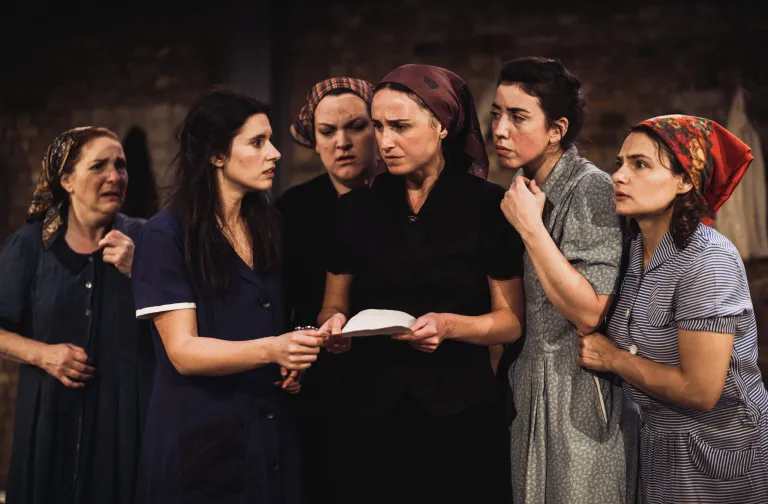
Pascal’s well-researched performance piece finds three young Jewish women taken from their comfortable, cultured lives in Paris to the internment camp in ‘free’ France, where, with nearly 60 more in their hut and hundreds more in their camp, they will starve, live among rats and lice, defecate in the open and in public and much more.
Pascal has the insight to see that it is not only their previous luxury that they miss – for one, Eva Daube (Ariella Barnett), for example, the remembrance of a sliver of unsalted butter on fresh bread is the once quotidian commonplace that has become an unattainable indulgence. Hannah (Mai Weisz), older, sterner, educated, and sexually experienced enough to have had an affair with her now dubiously Nazi professor, is a strong figure in this camp. Eva, barely out of school, remains idealistic, a communist as well as a Jew, a fighter. Charlotte (Anna Eckhard), an artist, struggles more to survive this appalling, apparently endless new world in which they are imprisoned and degraded for nothing more than who they are.
Dramatists are continually injuncted to find light in darkness, a task perhaps harder in the context of Europe 1940 than in most circumstances, and a task perhaps impossible in the context of Europe’s Jews. Pascal has chosen a fractured structure to provide 20-odd snapshot scenes of the horror, with each scene number announced and location/situation told to the audience. This choice of Brechtian distantiation, telling the audience what they are about to see, prompting them to consider the what and why of the events being portrayed as well as the performances and other theatrical contrivances, adds to the seriousness of what is in many ways as much a presentation as a traditionally dramatic performance.
This is not to say there is no joy to be found – the whirling dance and song with which the principal trio (Hannah, Eva and Charlotte) open the performance before they are placed on a bus to the south of France, for example, and several moving songs from the imprisoned women. It does mean that scenes are largely descriptive – we hear what characters say to survive from moment to moment, see what happens to them, but gain little of their interior lives, including that of the title character.
Pascal trusts her audience to come armed with pre-knowledge of who Hannah was and why she matters, and for that matter, of who, for example, Heidegger or Eichmann were, or the distinction between Vichy France and Nazi Europe. The detail of the performance lies, therefore, in the experience of these three women, and of representatives of millions more. One such is Agathe (Helen Goldwyn), an older doctor and voice of sense and calm authority, whom the pervasive dysentery or another sickness will claim before liberation or escape. Another actor, Anja Fahlenkamp (also responsible for excellent musical composition and arrangement) is listed as ‘Ensemble’ and, on being asked on arrival at the camp for her name, lists, and represents, many; not all stories can be told.
The performance comes closest to standard drama in a series of scenes involving a fifth named woman, Trude (Pat Dynowska), a thief and a former prostitute, whose ‘trial’ when she is caught stealing some bread from a fellow inmate is the most personally emotionally charged sequence. There is, regrettably, one small mis-step in the finale when Hannah, reunited in America after the war with Eva, recalls that they were three and asks what happened to Charlotte. ‘Gassed’, Eva replies, and we are sickened by the knowledge. But we hear nothing more of the fate of poor, lower-class, uncultured and uneducated Trude.
This is serious theatre, well researched, beautifully performed and choreographed, re-telling an aspect of a story that has been told many times in many ways since the 1940s. It strikes, perhaps as a result of its alienating theatrical structure, more at the intellect than the emotions. Yet that is, imaginably, no bad thing when the world around us repeatedly suggests that the tale can never be told so frequently or so well that its lessons will be universally learned and acted upon.
Arcola Theatre and Pascal Theatre present:
THE BANALITY OF EVIL: HANNAH ARENDT, FRANCE, 1940 by Julia Pascal at the Arcola Theatre 8 October to 7 November 2026
Box Office: https://www.arcolatheatre.com/event/the-banality-of-evil/
Cast
Ariella Barnett | Eva
Pat Dynowska | Trude
Anna Eckhard | Charlotte
Anja Fahlenkamp | Ensemble
Helen Goldwyn | Agathe
Mai Weisz | Hannah
Creative Team
Julia Pascal | Writer and Director
Carmen Neat | Set Designer and Costume Assistant
Tony Simpson | Lighting Designer
Anja Fahlenkamp | Musical Composition and Arrangement
Andrius Maksimavicius | Assistant Director
Naomi Shanson | Stage Manager (on book)
Poppy Stewart | Stage Managent placement/Assistant Stage Manager
Photography by Alex Brenner
David Weir writes The Westminster Mysteries novel series, including The Honourable Member for Murder and Motion for Murder. Plays include Confessional (Oran Mor, Glasgow), Murdering the Truth (Greenwich Theatre, London) and Better Together (Jack Studio, Brockley, London).