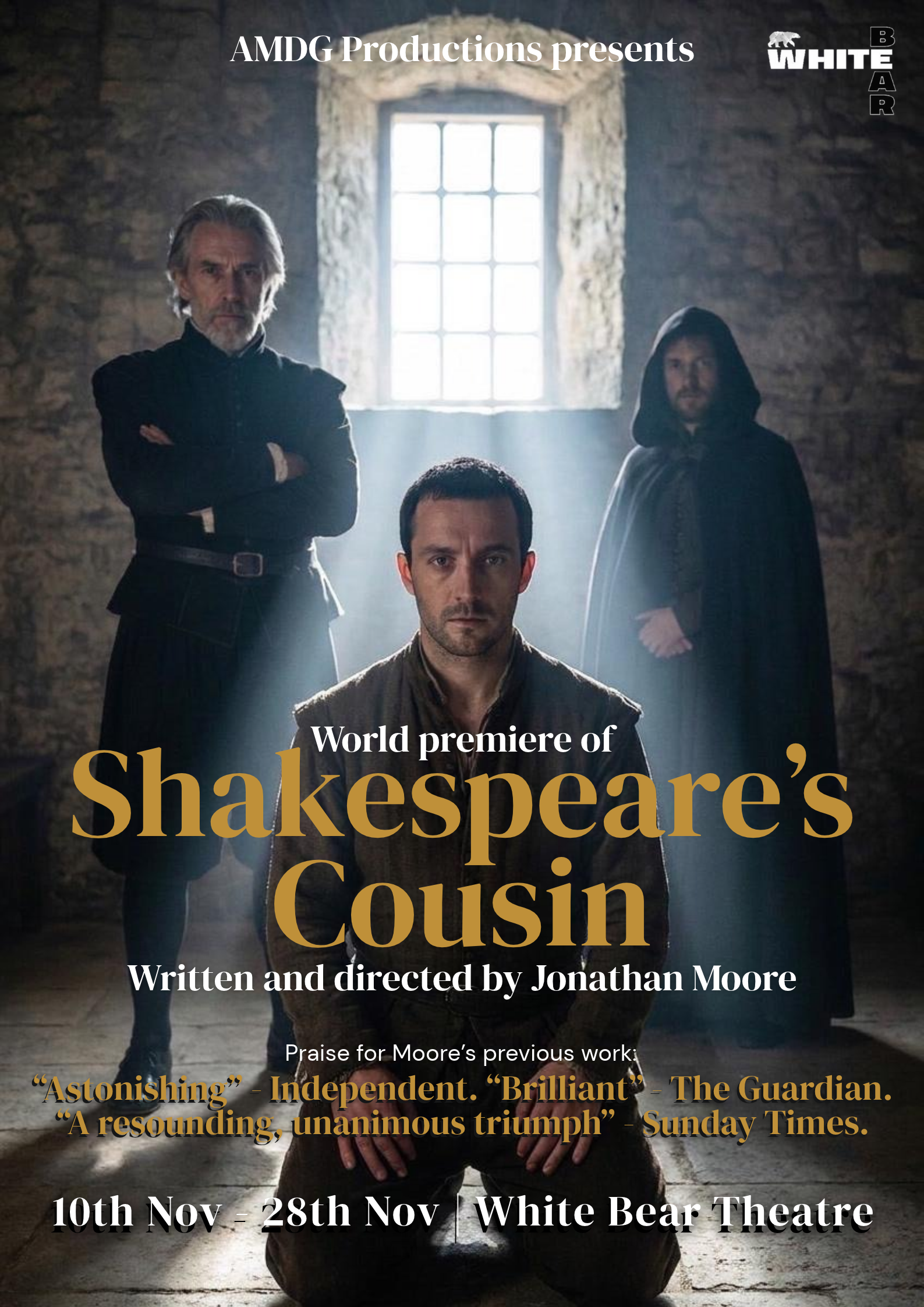



REVIEW: SHAKESPEARE’S COUSIN by Jonathan Moore at White Bear Theatre 10-28 November
‘Tudor religious divisions are still with us.’ ★★★★
Shakespeare’s Cousin is one of the most thoughtful, interesting, gripping and erudite history plays I have seen. It has a clear point of view, one which I happen to think is rubbish, but better a mistaken opinion than no opinion at all.
Writer and director Jonathan Moore is a practising Catholic, a cradle Catholic who attends Mass each Sunday, and, I suspect, by instinct a pre Vatican Two Catholic, instinctively uneasy with the Church’s twentieth century compromise with modernity. He marks out his ground with the name of his theatre company – AMDG Productions. AMDG (Ad Majoram Dei Gloriam – to the greater glory of God) were the letters I had to put at the top of all my work at my Jesuit school.
He believes, he told me, that the Reformation was the greatest disaster to befall this country. There is a passage in the play where the Anglican Sir Richard Topcliffe talks very much like a Brexiter about not being under the thumb of those dreadful Europeans any more. Moore seems to think that the idiotic English chauvinism that led to Brexit started with the Reformation; a view I do not share.
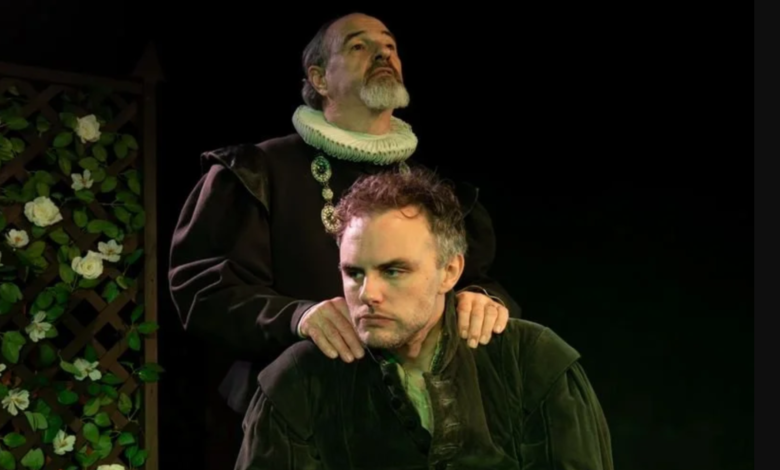
His protagonist is Robert Southwell, a poet and Jesuit priest who was arrested, tortured, and executed for high treason in 1595. As the play opens, Southwell arrives in a room with Sir Richard Topcliffe, and they exchange polite pleasantries, for all the world like one Elizabethan nobleman welcoming another to his house. But Topcliffe, after six years of hunting, has finally discovered the Jesuit’s hiding place by torturing and raping a woman friend of Southwell’s, and is about to subject his guest to the cruellest tortures in order to dig more priests out of their holes.
Then comes the torture. Topcliffe works from the torturer’s textbook: he starts by befriending his victim, has him listen to his friend being tortured, talks of torture being Southwell’s choice, describes the torture in excruciating detail. It is how successful torturers everywhere operate.
All this is presented brilliantly on the small White Bear stage. Southwell is played with restraint, emotional intelligence and sensitivity by Danny Solomon. Robin Kingsland’s Topcliffe is no straightforward moustache-twirling villain. Kingsland puts in such a thoughtful performance that occasionally you find yourself almost understanding what drives him and caring what happens to him – cruel, vindictive and deeply nasty human being though he is. The two make Act One a gripping theatrical experience.
The show goes off the boil a little in Act 2, when William Shakespeare (interestingly played by Alex Townson as a shallow and equivocating writer) improbably talks his way into Southwell’s cell in disguise. Even more improbably, instead of making some plans, they engage in several interesting, but wordy, debates, and one is left wondering why Shakespeare took the huge risk of visiting Southwell in disguise, if all he did there was to have a debate.
Southwell wants Shakespeare (who according to this play was a closet Catholic) to write more of the truth, to campaign through his writing – a very dangerous thing to do in Tudor England. Shakespeare replies that his forum is a playhouse, not a pulpit. It’s certainly true that Shakespeare frequently wrote what it was politically expedient to write rather than what was true – the most notorious example being Richard 111.
Jonathan Moore’s play reminds us that the religious battles of the Tudor and Stuart period are far from over. To this day, Catholic and Church of England schools teach those turbulent times differently.
How you view fireworks on November 5 depends at least in part on whether you were taught by Catholics or Anglicans. Catholics applauded Robert Bolt’s 1960 play A Man For All Seasons, which lionised the Catholic Thomas More – St Thomas More – and made his enemy Thomas Cromwell into a black-hearted villain. Anglicans had to wait until 2009 for Hilary Mantel to deliver their revenge for them.
My Jesuit schoolmasters taught me much about the dreadful cruelties Elizabethan England meted out to Catholics, and about the bravery, dignity and sanctity of men like Southwell – St Robert – and Edmund Campion – St Edmund. We learned little about those Anglicans who suffered the same fate under Elizabeth’s predecessor Mary, and the Catholic Church does not call them saints.
Jonathan Moore does mention those killed under Mary, and makes Southwell condemn it: “Murder one human being and you murder all humanity.” But I am not sure that was the view of the Jesuit martyrs. Reading Evelyn Waugh’s excellent biography of Campion, I find a man who is not so much disgusted by the fact that there was religious persecution; what really troubles him is that the wrong people are being persecuted.
SHAKESPEARE’S COUSIN by Jonathan Moore at the White Bear, 10-28 November 2026
BOX OFFICE https://www.whitebeartheatre.co.uk/whatson/shakespeare%E2%80%99s-cousin
Writer and Director: Jonathan Moore
Associate Producer/Assistant Director: Max Bancroft
Set Designer/Costume Supervisor: Violet Gausden
Lighting and Sound Designer: Gabriel Burns
Specialist Prop Maker: Deb Weston
Presented by AMDG Productions
Photo credit Kai Dorovk.