








REVIEW: ECHOES by Lieve de Putter at Etcetera Theatre 26-28 August 2026
“A powerful and confrontational reclaiming of female narrative.” ★★★
Before ECHOES has even begun, writer-performer Lieve de Putter has scattered its central idea across the auditorium. On each audience seat is a scrap of paper bearing a tiny fragment of poetry. We later discover that these are words attributed to Sappho - remnants of the work of one of antiquity’s most celebrated poets, much of whose writing has been lost.
De Putter opens with a voiceover offering two versions of the same narrative. A male voice describes a woman through a sexualised lens, lingering on her “seductive” lips and “soft bosom”; beneath it, a female perspective concentrates instead on her nervousness. The action has not changed. The woman has not changed. Only the person describing her has.
That distinction - between event and interpretation, subject and storyteller - sits at the heart of ECHOES.
Moving between women from classical mythology and the life of a modern woman, De Putter examines stories in which female characters have repeatedly been defined by the men interpreting them. Echo, Philomela, Cassandra, Arachne and Helen are variously silenced, disbelieved, punished for speaking or denied control of their own narratives. History may be written by the victors, but ECHOES argues that our cultural stories have also overwhelmingly reached us through a male lens, making this a powerful and occasionally confrontational reclaiming of female narrative.
Some of the most fascinating material concerns language itself. De Putter digs into the etymology and translation of particular words, questioning assumptions made by generations of male scholars and demonstrating how linguistic choices can fundamentally alter our understanding of a woman’s actions, desires or culpability. Her discussion of the comparatively recent arrival of women translating and interpreting classical texts is particularly compelling. It is fascinating - and more than a little infuriating - to discover how profoundly a single translation choice can alter our perception of a character: Helen’s self-description, for example, has been rendered by male translators as “whore”, where the original Greek invokes the image of a “dog-face”.
There is a great deal of material here, perhaps too much for the running time. Some stories are given considerably more room to develop than others. Echo is cleverly reimagined through a modern job interview with a narcissistic boss, who responds enthusiastically as she begins repeating his own words back to him. It is witty, accessible and allows the ancient myth to emerge naturally through a recognisable contemporary situation.
Elsewhere, the connections are more dependent on prior knowledge. Cassandra walks through the ruins of Troy declaring that she warned them, but nobody listened - an affecting image if you already know her story, but one given little context for those who do not. ECHOES admirably refuses to spoon-feed its audience, yet several scenarios pass so quickly that they feel more like fragments than fully developed stories. Rather than building towards one clear dramatic journey, the piece can feel like a succession of fascinating ideas placed alongside one another. An expanded version would give both the individual myths and the contemporary character journey more room to breathe.
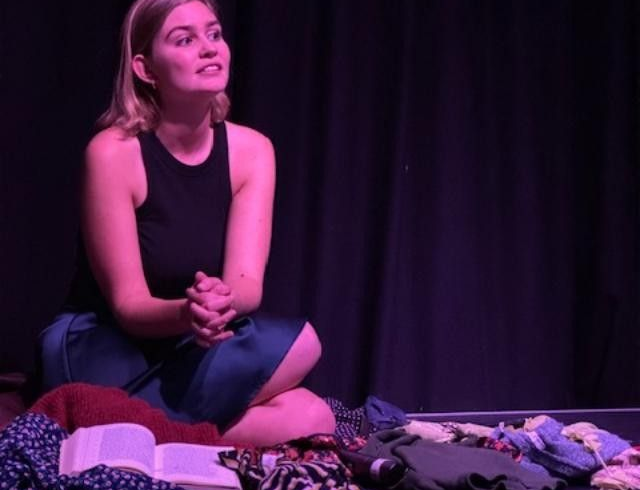
Visually, the production is deliberately sparse but thematically rich. Women’s clothes lie strewn across the floor, becoming both markers for the different characters De Putter inhabits and a recurring image of female storytelling. Textiles run through the piece as a means by which silenced women can make themselves heard: Philomela, her tongue severed, communicates what has happened to her through cloth, represented here by a white scarf bearing her story, while Arachne weaves stories into fabric and is punished for what she depicts. De Putter’s wider point is that women did tell their stories - they simply told them in the forms available to them. Cloth deteriorates. Those stories were not preserved. The scattered garments therefore become fragments of women’s narratives, left behind and gradually lost.
De Putter gives a committed and engaging performance, moving between ancient women and contemporary experience with clarity. The everyday negotiations and diminutions faced by a modern woman - in the office and in interactions with her father - sit alongside their mythological counterparts, creating the uncomfortable recognition that, despite the centuries separating them, some things have changed remarkably little.
ECHOES is at its best when it makes us reconsider something we thought we already understood: a familiar myth, a translated word, a description of a woman’s behaviour. It asks not simply whose stories survive, but who has been allowed to tell them.
Challenging, intelligent and compelling, ECHOES is clearly the product of considerable thought, research and imagination. Its central ideas are fascinating, its visual language carefully conceived, and its reclamation of female voices feels both urgent and worthwhile. Where the piece falls short is in execution: too many of its stories are compressed into too little space, and without a strong enough narrative throughline, its individual moments do not always cohere into a fully satisfying whole. There is an even richer and potentially very powerful piece of theatre within this material, and one well worth developing further.
Box Office: https://www.etceteratheatrecamden.com/events/echoes