


‘Alexa, help me grieve’:
the woman using AI in an award-winning show about losing her mum to COVID.
By Harry Speirs 10 April 2026
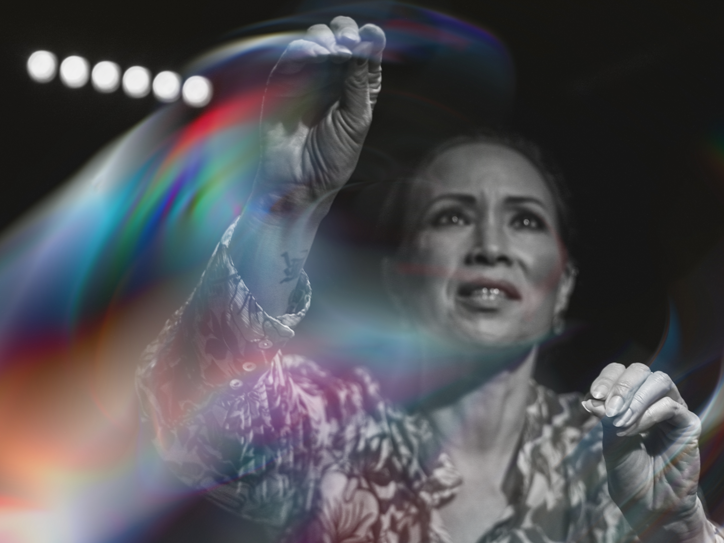
As London’s theatres rebuild after the impact of Covid-19 and adapt to technological advances in Artificial Intelligence (AI), Nikol Kollars returns to the UK with a timely stage piece about using AI to remember the mother she lost to the virus.
Kollars appears on screen, its glow glinting off a swanky, stylish pair of thick-rimmed glasses. It has been a chaotic weekend of rescheduling calls as she travels from Spain to London, preparing for the second run of her one-woman show, Fickle Eulogy, at the Circle and Star Theatre in Hampstead this April.
After a considerable screen career, with roles spanning Apple TV+ and the Netflix crime drama Paranoid, Kollars began writing for the stage through poems, journalling and dialogue in the aftermath of her mother’s death. At the time, she was on a film set in Estonia. The idea became the starting point for a piece that would go on to win a Standing Ovation Award for Best Solo Performance from London Pub Theatres.
“Doing a show the second time, especially such a personal, vulnerable show discussing rapidly advancing technology, will always feel completely different each time,” she says.
There was little space for her to grieve. “I never had time to process it,” she says. “When my mum died, it was during a film shoot, and I could only fly back to Washington state for a week to be with my family,” Kollars says.
Kollars was unable to be physically present in her mother Penelope’s final moments, relying instead on WhatsApp and video calls to remain connected at her hospital bedside. “I was lucky enough to hear her say ‘I love you, honey’ to me and my son,” she says.
“Writing and Alexa were the only things I had,” Kollars says, recalling how she wrote the AI voice service as a central part of the script. “Alexa mjust help the main character, Anne, write the eulogy celebrating her mother’s life at a family event, and it’s driving the protagonist crazy,” she says, laughing.
Her family opted for a “celebration of life” as a personal, uplifting alternative to a traditional funeral. Kollars, herself, wasn’t able to actually be present due to the lockdown restrictions at the time, but she did manage to produce the list of songs for the event.
We discuss how the role of technology has shifted since she first performed the piece. “We need to be very careful about how dependent we are becoming on AI platforms,” she says. Kollars mentions its role in self-therapy, the extent to which people have become hooked on their phones, and how theatre offers a way for her to push back.
“On stage, you have a very controlled space and, while AI may be dominating our lives in the real world, during the one hour of my piece, I have complete control over what Alexa is saying,” she suggests with glee.
Towards the end of the show, Kollars projects a larger-than-life, AI-generated image of her mother speaking to the audience in a futuristic spacesuit that looks like it is straight out of a film. “This moment is meant to feel feel a bit silly and ridiculous. I wanted to see how people reacted. Do they want actual actors on the screen and stage? She is keen to stress the importance of human presence in both cinema and theatre. “There are a lot more screen actors embracing theatre now. There’s no reward. No retake. You just dive right into the chaos,” Kollars says.
Timothée Chalamet recently got on her nerves with his comment that no one cares about opera and ballet anymore. “Are you kidding me?”, she says, “I think he’s an incredible actor, but these art forms are so alive — it was very ignorant.”
“I actually think theatre may be safer for actors as it relies on people being present in the room,” Kollars adds. She has noticed even at corporate events that people prefer to have a real, human presenter for entertainment at work-dos. It is not to say that Kollars does not worry about AI and technology for her children’s generation. “Kids are growing up without a reference to reality,” she says, “on social media, they might see a polar bear at a barbecue taking a hot dog and believe this is something that can happen.” A worried grin appears on her face.
“Performing live allows me to see the emotions and grins on people’s faces, and theatre has this way of exchanging energy between people,” she claims. Kollars suggests many people have not fully come out of lockdown socially and remain hooked on the digital world. She has a friend, another actor, who spends most of the day using a virtual reality headset. “When you meet him, he’s very social and great for conversation, but I always find it fascinating how he spends so many hours with these big digital glasses on,” Kollars says.
FICKLE EULOGY by Nikol Kollars is at The Circle and Star Theatre in Hampstead 7 - 12 April