
The Face Within The Face at Etcetera Theatre 26 April 2026
‘fascinating and informative’
London based Central Drama Lab focus on theatre making and performance research. The Face Within The Face workshop included live performance, interaction with mask making and painting, and an opportunity to ask questions of the crew.
The performance consisted of a number of demonstrations, video and a talk. The demonstrations were accompanied by composer and musician Ding Mingyu. A mention here of his expertise which included improvisation on the piano, creating very beautifully sonorous sound which made a contrast with his percussion instruments. These were used to more dramatic effect, accompanying the performer Zhijie Zhang making the sounds of insects on a forest floor, a monkey and a dragon.
The overall concept for the two-hour workshop was in the pursuit of finding a way to take the Chinese Opera, with its fixed forms, to new artistic pathways allowing the old to meld with the new. The response to this included video design. These projections were almost kaleidoscopic with complex patterns and repetition suggesting the precise and exacting movements and expressions of Chinese opera.
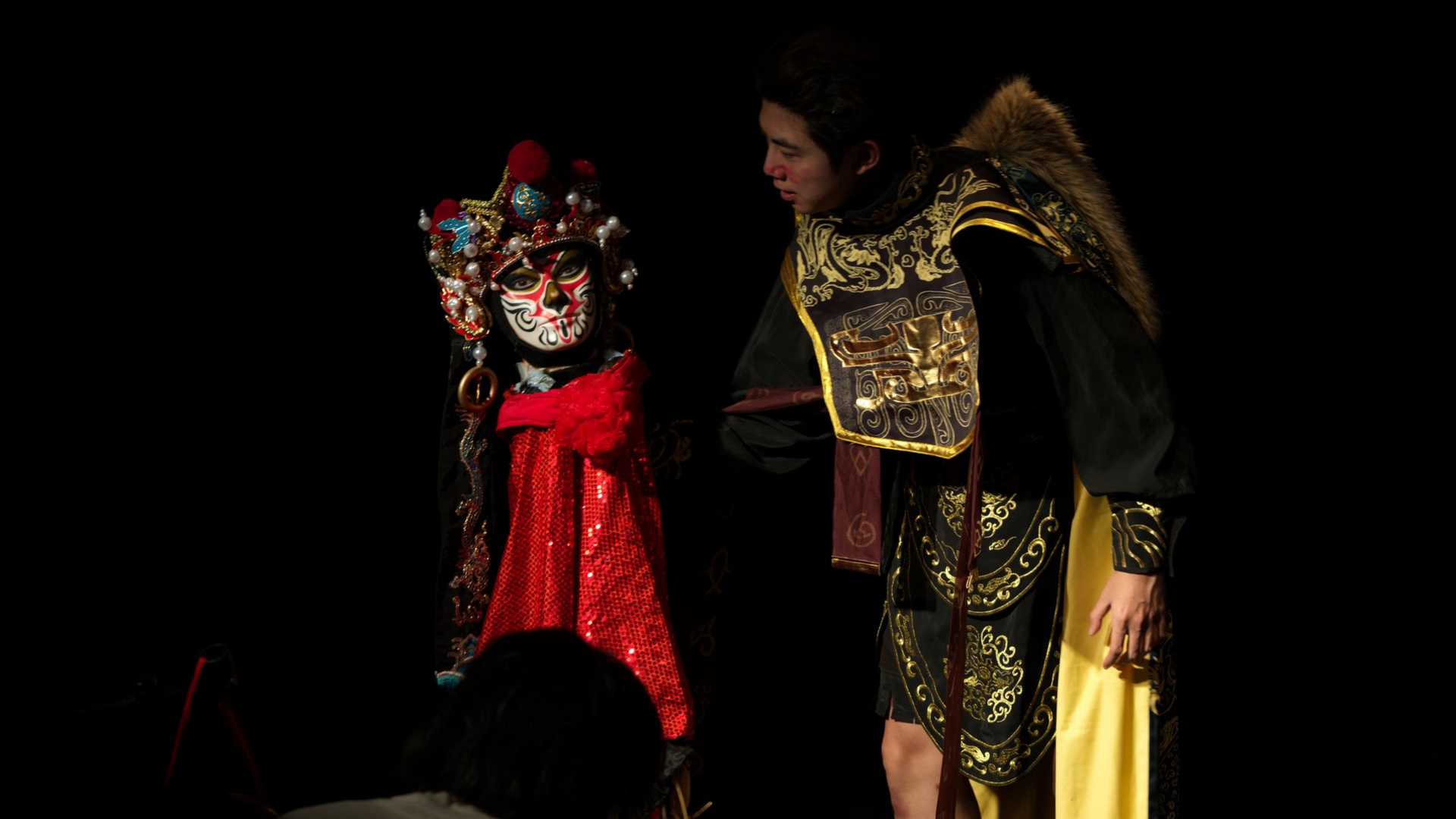
The performer gave us a demonstration of Sichuan Opera face-changing techniques. It might be assumed that he would take one mask off to replace it with another, but it was far more magical than that, as it happened in the blink of an eye. The secret is that the soft masks are attached to a piece of cotton, which is pulled away revealing another face. It was a stunning performance aided by the costume design by Shuai who used traditional designs. One of these was a fabulous sun which he painstakingly printed onto the fabric. The costumes were very complex with many pieces which flowed around the performer enhancing his physicality.
Artist Yimei Du brought something entirely new, her own artistic practice in a performative style. She created a ‘doll’ on stage using a wire frame, tissue paper and tape. It was very fragile and had the look of a seated Emperor wearing fabulous robes. At this stage she didn’t add any colour. In the question-and-answer part of the workshop, she explained that she takes her inspiration from origami and in performance she is making a facsimile of the other performer. It is a shadow of him. Having only observed him from the wings, the model had no colour, because the colours he was wearing could not be seen from her perspective, he appeared to be in black. Thus, she honours her lived experience in the moment, and in this way, she makes a ‘living sculpture’.
During the workshop there was also an attempt to combine Sichuan Opera Face-Changing with the Vakhtangov approach. This was led by senior lecturer Oleg Mirochnikov from Central Saint Martins, University of the Arts London who gave a demonstration. This was perhaps less successful than the other performances, it feels uncomfortable, a little forced, but this is the nature of experimental theatre and research. We don’t know where it might lead.
Overall, praise to director Yi Tang for bringing this intriguing and ambitious work to the stage. It’s a fascinating insight into an ancient artform, and very enlivening to see how artists are responding to this and using it as inspiration for their artistic practice.
Central Drama Lab is an independent theatre production company
Yi Tang — Director
Oleg Mirochnikov — Artistic Director
Sheron (Xiaoran) Luo — Technical Director & Lighting Designer
Xuqian Gao; Guo Cheng; Shuai — Curatorial Team
Ding Mingyu (Ming) — Composer, Arranger & Sound Designer
Zhijie Zhang — Performer
Yimei Du — Live Face-Painting Artist & Interactive Performer
Shuai — Costume Designer
Zixin Huang — Digital Interaction Designer
Mia Cousins — Stage Manager
Yiqian (Joe) Huang — Producer
Jenny Cheng — Graphic Designer (Poster & Programme) & Exhibition Guide
Yi Zhou (Zoey) — Photographer, Videographer & Digital