





Stephanie Lake’s COLOSSUS at Southbank Centre’s Queen Elizabeth Hall 25 – 27 June 2026
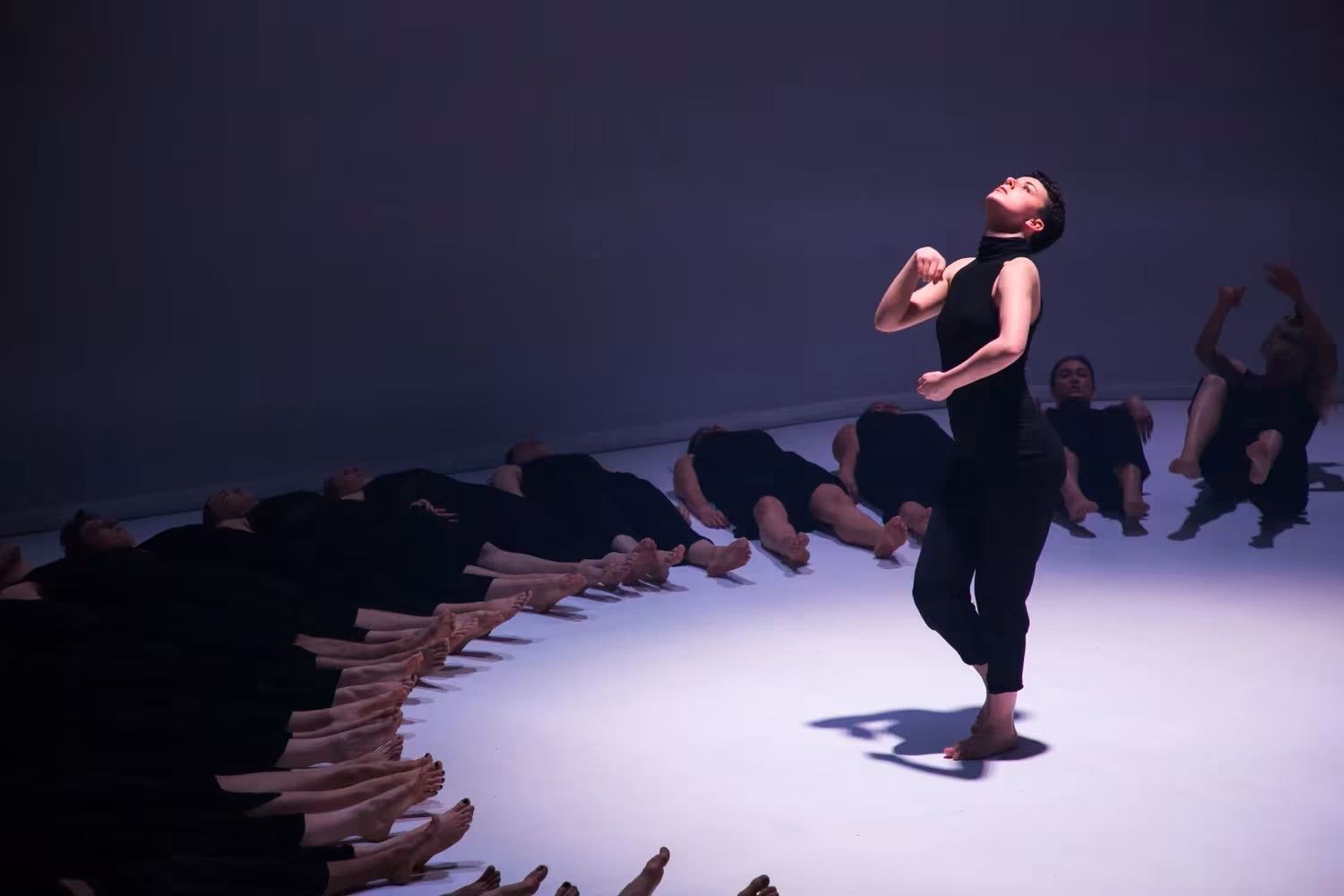
‘Fifty dancers become crowd, community, machine and organism all at once.’ ★★★★ ½
Stephanie Lake’s Colossus is a work of scale, pressure and collective energy. Performed by the students of London Contemporary Dance School, the piece brings fifty dancers onto the stage and asks them to move, listen and respond as one shifting body.
The opening is immediately striking. The dancers stand together in a dense formation. Small gestures begin to pass through the group: a hand lifts, a head turns, a body folds, another responds. The effect is simple but powerful. The stage becomes a field of signals, each movement setting off another somewhere else.
Lake’s choreography is at its strongest when the cast of fifty appears as one enormous body. Energy passes from dancer to dancer, sometimes through a small gesture, sometimes through a sudden shift of weight or direction. The group does not simply move at the same time; it seems to breathe and react as a single organism.
This sense of shared impulse gives the work much of its visual power. The dancers move in waves, circles and tight clusters, forming patterns that change before they can settle. At times, they appear almost mechanical, driven by rhythm and repetition. At others, the movement feels more human, uncertain and exposed.
With so many bodies on stage, precision becomes more than a technical demand. It becomes a question of trust. Each dancer has to stay alert to the space, the timing and the people around them. They must keep moving while allowing others to pass, fall, turn or interrupt. This gives the piece much of its tension. It always feels close to disorder, but rarely loses control.
There are moments when individual dancers briefly come into focus. A solo phrase, a sudden break from the group, or a sharper physical accent allows one performer to appear more clearly. These moments are often short. The dancer is soon absorbed back into the mass. That return is important. Colossus is not interested in individual display for long. It keeps asking what happens when a single body is held inside a larger collective force.
The most effective sections are those where rhythm gathers across the full cast. Feet strike the floor, bodies pulse, and repeated gestures become almost overwhelming. A small action, multiplied by fifty dancers, becomes something much larger: a crowd, a machine, a ritual, or a body too big to control.
The quieter passages are just as important. When the movement reduces into stillness or minimal gesture, the stage remains active. The dancers continue to watch and listen. These moments reveal the discipline behind the spectacle. The power of Colossus is not only in its speed or scale, but in the attention required to hold such a large structure together.
As a graduation performance, the work is a demanding choice. It gives the students little chance to hide. Everyone is visible, and everyone is responsible for the rhythm of the whole. The cast meet that challenge with commitment and alertness. There is youthful energy, but also a serious understanding of ensemble work.
Colossus does not need a clear narrative to make its point. It shows how bodies can gather, separate, obey, resist and return. It makes social pressure visible through movement. The dancers become crowd, community, machine and organism all at once.
By the end, the stage feels both exhausted and charged. The group has built something larger than itself and then had to survive inside it. This is a bold UK debut for Lake’s work, and a strong final statement from the LCDS students. Colossus is impressive not simply because there are fifty dancers on stage, but because those dancers are made to think, move and respond together. The result is a performance of collective force, full of pressure, risk and restless energy.