




REVIEW: Arthur and Marilyn at The Lion & Unicorn Theatre 17 - 21 March
“Arthur and Marilyn is a fantastic example of what can be accomplished when two excellent actors are put on stage with a clear story to tell” ★★★
Despite Marilyn Monroe’s enduring status as one of the most recognisable celebrities and symbols in popular culture, few references to the blonde bombshell include mention of her five-year marriage to the playwright Arthur Miller. Similarly, though Miller remains one of the most celebrated American playwrights of the 20th century, his romance with Monroe is but a footnote in his legacy.
Arthur and Marilyn
is a rebuttal to the cultural amnesia that has left their romance lost to time. Steve Barker’s 90-minute play tells the story of Monroe & Millers’ relationship from their Hollywood introduction through their 1961 divorce and suggests that our cultural inability to reconcile their relationship against their incongruous reputations and roles in our collective memory just might reflect the paradoxical reality of the relationship itself.
Arthur and Marilyn
paints young Monroe as a wide-eyed actress with a youthful excitement and desire to be taken seriously. Her character is subsequently pushed further and further into the depths of her drinking as she experiences the loss of control over her life and body. Her mental health worsens as she struggles against a world dominated by men who both trivialise and exploit her. For Monroe, intellectual Miller is an opportunity to be taken seriously by association and to experience male protection over abuse. For Miller, Monroe represents the ideal of mainstream America at the precise time that his American-ness and assimilation as a Jew is in question.
Arthur and Marilyn
does not suggest the two were not authentically in love but, rather, that the very differences that attracted them to each other would become their eventual undoing.
Barker’s script is, of course, fictional. Though it is based on real people and events, the play does not purport to meet journalistic standards. Nevertheless, it is notably sympathetic and arguably biased towards Miller. Arthur remains the voice of reason throughout the play, but his rationality becomes increasingly mythologized against entirely irrational Marilyn. In
Arthur and Marilyn, Marilyn’s growing erraticism is attributed to a downward spiral induced by mental health struggles and alcohol abuse. In one of the couple’s happier moments, Marilyn summarizes her tragic childhood, presumably as context for the portrayal to come, but sympathy to her character does not feel genuine. Though there is a small attempt to substantiate her paranoia as a symptom of the patriarchy - it is clearly intentional and representative that the sole person Marilyn comes to trust is the sole female character in her orbit -
Arthur and Marilyn
fails to humanize Marilyn’s struggles beyond sexism and the oblique concept of stardom. We are allowed to empathise with her role as a sexual object and cultural obsession, but no further. By contrast, Miller is almost above reproach. He’s portrayed as a near-saintly husband, succumbing to Marilyn’s irrational whims, despite his greater intellect and unassailable morals.
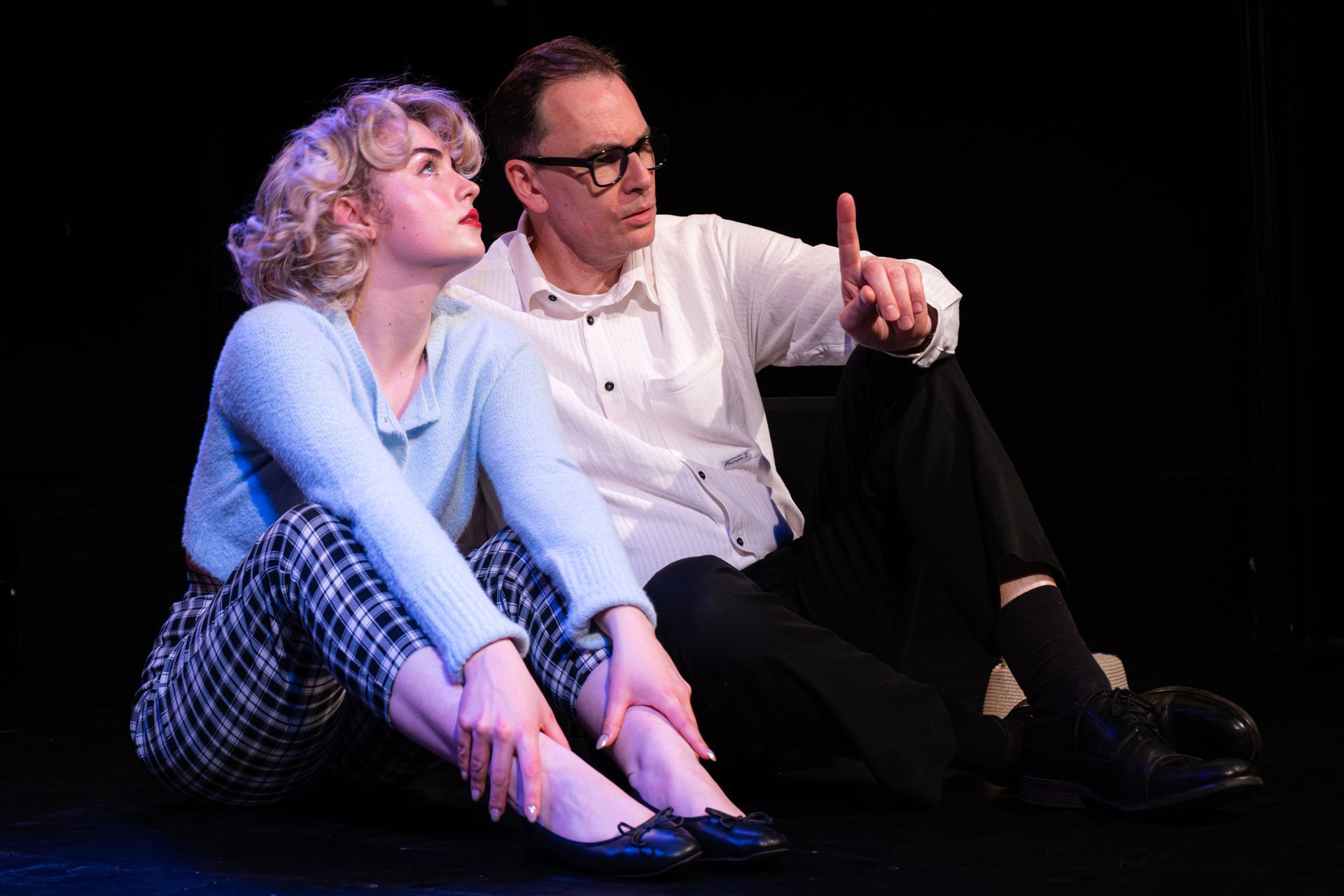
Daisy Snelson and Marcus Churchill deliver exceptional performances as Marilyn and Arthur, respectively. Churchill is entirely believable as an erudite playwright with a sense of humor and politics that landed him on the politically right side of McCarthyism. His likeability is probably at least partly to blame for the too-easy likeability of his character. Snelson, as well, manages to deliver an effervescent and powerful performance of a character who would likely come off far less sympathetic on the page. Snelson’s Marilyn is charming, innocent, shy, arrogant, sad, vivacious, right, wrong and human, something Marilyn Monroe rarely gets to be.
The show also features excellent direction by Sarah Paterson. The performers manage to tell the entirety of Arthur and Marilyns’ story using just a few stage cubes and two liquor bottles. Music is expertly employed to evoke 1950s New York City and costuming is genuinely transformative. Snelson brings Marilyn to life in both performance and look.
Unfortunately, though the play recounts the facts of Marilyn and Arthurs’ story, it does not justify its significance.
Much like
Love Story,
the Ryan Murphy-produced series based on the real-life romance of JFK Jr. and Carolyn Bessett currently airing on Netflix,
Arthur and Marilyn
is a window into a largely untold but significant historical love story. Both
Love Story
and
Arthur and Marilyn
feed our human hunger for celebrity scandals and ‘authentic’ behind-the-scenes looks at the private lives of the rich and famous. Unfortunately, both pieces of work lack clear commentary or connection between their histories and our present. In
Arthur and Marilyn, connective threads between McCarthyism and contemporary American politics, for example, remain unused.
Nevertheless,
Arthur and Marilyn
is a fantastic example of what can be accomplished when two excellent actors are put on stage with a clear story to tell, sans gimmicks. The show’s 90-minute run-time flies and audiences of all ages, with any level of familiarity with the real Marilyn Monroe and Arthur Miller, will be thoroughly entertained.
17–21 March 2026
The Lion & Unicorn Theatre, Kentish Town. (42-44 Gaisford Street, NW5 2ED)
Tickets: £15 / £13 concessions
Book now: https://www.thelionandunicorntheatre.com/
Photography: Wesley Anthony