

Mehmet Ali Nuroğlu’s Dünyada at The Cockpit 3 - 9 Aug for The Camden Fringe
“Audience members will not soon forget Dünyada or its incredible soundtrack” ★★★
For one week only, acclaimed Turkish actor Mehmet Ali Nuroğlu brings his innovative, 70-minute solo show Dünyada to The Cockpit Theatre as part of The Camden Fringe. Dünyada comes to London following a series of performances in Turkey, and the global nature of the play is reflected in its title, a Turkish word that roughly translates to “in the world.”
Dünyada reimagines the monologue Title and Deed, of the same length, written and performed by American playwright Will Eno in 2012. Nuroğlu keeps the original script on stage with him, occasionally flipping through the pages – deciding which words and ideas to use, and which to abandon. Eno’s script opens with the line “I’m not from here,” as does Nuroğlu’s, but audiences need not be familiar with the source text to appreciate Nuroğlu’s work. In Dünyada, he does something unique, though the performance remains an exploration of being “not from here,” and the similarities and differences between people, etymology, and language. Dünyada is about the universality of the human experience, at the same time it is about disconnect, isolation, and the idea that we are all just a context-change away from being an outsider.
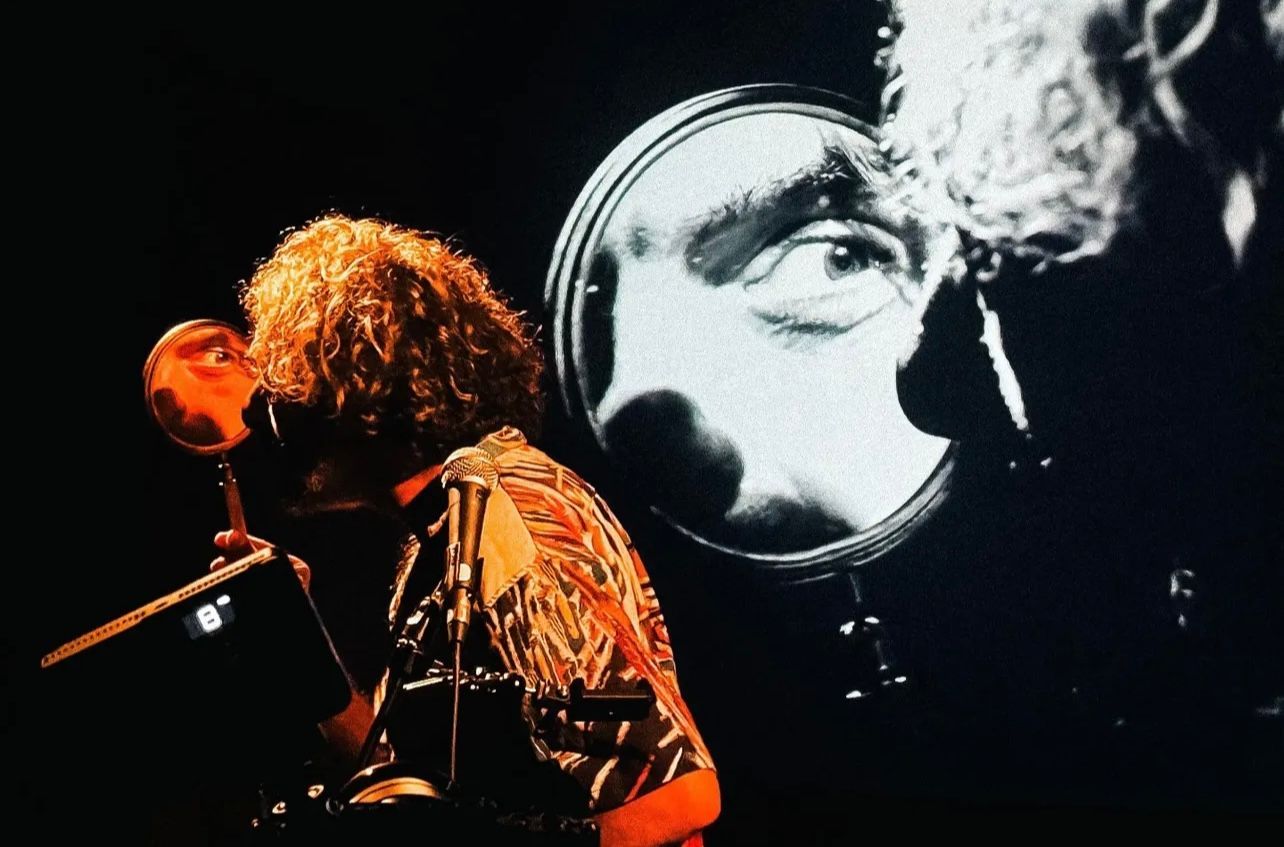
Nuroğlu creates a distinct character so entirely embodied, it becomes impossible to separate from the man on stage. At the same time, he holds a video camera to the audience and himself, handling his own camerawork and cinematography, in real time. These visual elements provide clear commentaries on surveillance and the contemporary need to reinforce identity via media. Nuroğlu’s live and experimental camera-work is perhaps the most stand-out part of the play. His use of an on-stage loop machine, by contrast, is impressive, but less thematically clear.
The most standout visual and audio moments involve the use of unremarkable objects to create unexpected and moving effects. At one point, Nuroğlu uses paper and ambient sounds to create the effect of a rainstorm. In another particularly poignant moment, he captures the exact right blur of the theatre lighting to create the illusion of snow.
When Nuroğlu turns the camera on himself, his commentary is incisive; he implicates both himself and his audience’s gaze. The camera lens becomes more problematic when turned on individual audience members. On the one hand, it’s a very clever trick. Nuroğlu uses the faces of particular audience members to represent the characters absent on stage. He returns to the same two people to represent “mother” and “father.” While the website references this interaction, there is no way for audience members to opt-out. Though certain attendees may enjoy on-stage reflection, the camera lingered on some faces long enough to detect discomfort. This became increasingly distracting, but could’ve been easily mitigated with a non-participation section or by keeping the camera just on audience members’ eyes.
Dünayda comes to The Cockpit following upwards of twenty performances in Turkey. Much like its subject matter, the piece translates across languages and cultures because the human experience is both vast and singular. For this reason, it also changes dramatically based on cultural context. With only this viewing experience, the play seemed to be about the experience of being “not home” but, specifically, abroad – the monologue opens with descriptions of airport lines and passport control. The subtext that comes up in a London venue undoubtedly differs dramatically from the performances in Istanbul, though I cannot speak from personal experience.
Audience members will not soon forget Dünyada or its incredible soundtrack – a mix of Turkish R&B. Though the piece never totally finds its footing, Nuroğlu’s performance is undeniable. In just 70-minutes he creates an entire multi-media experience full of thoughtfulness and dry comedy.
Dünyada
is on at The Cockpit through to 9 August. Information and tickets are available at https://www.thecockpit.org.uk/show/d%C3%BCnyada.